Sunday, 3 March 2013

Tumblr

I am continuing to look at the idea of identity within my work, however I have extended the concept of Identity by exploring the use of Tumblr.

My daughter and others seem to use Tumblr for many reasons, as a diary, to advertise their work, and for personal reasons, according to Emma, she uses her Tumblr account to be herself through imagery, and limited text, her site is a visual record of how she feels, her values and interests. Furthermore Emma feels that she is not judged and she fits in.. I find this fascinating, that by creating a site in which everybody can view and reflecting on these expressions of herself (I do have parental control).

Tumblr is different from Facebook, I use Facebook to record day to day events and to share my work, and interests through text and photographs for my friends and family to keep in contact, whereas Tumblr is so different more obscure in a way.

So Emma has contacted some of the people who are followers of her Tumblr site and certain individuals have allowed me to see their images and photographs of their Tumblr page and to use images as well, which is amazing because these individuals are all exploring their identities and their lives through these images.

One such person has this image where she is seated on a doorstep, and this is an image that I have taken to create a piece of work.
This particular individual is a student and is studying fashion design, her style is very individual and she is confident in that developing style which is based mainly 1950's retro style.

The piece I wanted to create was to look at the composition of the figure in the piece.


The colours I have used are vibrant, and I look at this piece and believe that tonally restricting the colour would have made a more interesting piece.   


I found the finished piece a good beginning because I feel that the piece should have been more controlled in the use of the colour and I feel a limited palette would change the impact of the painting.  


Looking and studying this piece I am interested in reworking the piece, because compositionally I feel the cramped space in which the figure is placed and expanse away from the individual, creates a interesting image that for me personally works, however would a limited palette produce a more interesting, arresting image.

I have just finished another piece and this work shows how the limited palette has created a completely different feel to the atmosphere.


 This piece is created on a reused canvas, which I have sanded back the old image and then primed the canvas. The reason I chose this canvas is because its damaged and feel used and abit battered.


As in this piece and most work I create, I work on the area of main focus and then outwards onto the background, I then dip back and forth between the figure and background, or the background is at times completely left until the figure or area of interest is completed.
I know that this is working back to front as most teachers and artists state that an artist or anybody creating a piece of work, they should work the background to the fore,


Hands and feet are areas I really struggle with, and I have to spend a lot of time study the physical aspect of the form, and I have to picture where the muscles, tendons and skeletal elements are, and then the tonal qualities have to be taken into account.


Often I have to turn the canvas around especially with areas such as the hands as shown above, in doing this I can figure out the dimensions easier.


Tonally this piece is sombre and I am very interested in exploring how less in more when taking into consideration the tonal aspect of work and how reducing the amound of colour introduced and a limited palette changes the atmosphere of the piece.


The image above does not clearly show how I have left the linear marks of how I use pencil to sketch out the figure, I have done this as it adds an interesting to the piece, this creates the sense that this is a painting and not just a portrait of somebody.
The artist Gerhard Richter in his work has often kept in the linear marks created especially within his portraiture works. **Need to find info that backs this claim from one of his exhibitions!!!**
 
  
I am pleased with the result of this piece, I realise that compositionally the piece is traditional, however the piece does reflect an individual constricted within the confines of the edges of the canvas. 
This piece compared to the first painting I feel is more evocative and even though it is more conventional in its composition, it is a stronger piece, and with this in mind I will recreate the first piece which tonally will be more muted and use a limited palette.  

In the never-ending debate between blogging and micro-blogging, Tumblr usually gets lumped in with Twitter and Facebook on the micro-blogging side. But Tumblr is actually somewhere in between the status bursts of Twitter and Facebook and the long-form publishing of WordPress-style blogs. If anything, it is more accurately described as micro-blogging than Twitter or Facebook because you actually produce short blog posts filled with images, links, and videos. But the key to Tumblr’s incredible growth—it’s adding a quarter billion pageviews a week—is how easy it makes it to post something and reblog what your friends are posting.
Tumblr CEO David Karp recently sat down with Chris Dixon for a Founder Stories interview in which explains how he started Tumblr four years ago as a reaction to other blogging tools out there. “All blogs took the same form,” he notes. “I wanted something much more free-form, much less verbose.” People wanted to express themselves and blog, but he felt that the standard blogging platforms available at the time—Wordpress, Blogger, TypePad—were too complicated. “These tools I just don’t think worked for most people. It’s a commitment, you need to sit down for an hour and hammer out a post.”
He is quick to add that “WordPress is the best tool in the world for that” kind of publishing. But for someone like him who “doesn’t enjoy writing,” it was the wrong tool. So he created Tumblr instead, which is designed to help people get their thoughts and images up as quickly as possible, and to lower the barrier to publishing even more.
But don’t Twitter and Facebook lower those barriers even further? They do, but they lack a strong expressive identity, argues Karp. “They are not tools built for creative expression,” he says, adding: “Nobody is proud of their identity on Facebook.” Okay, he’s got a point there. Tumblr, in contrast, is built to be a place you can be proud to call your online home. It’s very design-oriented and you can customize your Tumblr to reflect your personality, but not in a cheesy MySpace way. For Twitter and Facebook, “expression isn’t necessarily something they care about.”

http://techcrunch.com/2011/02/21/founder-stories-why-david-karp-started-tumblr-blogs-dont-work-for-most-people/


Tumblr is a re-envisioning of tumblelogging, a subset of blogging that uses quick, mixed-media posts. The service hopes to do for the tumblelog what services like LiveJournal and Blogger did for the blog. The difference is that its extreme simplicity will make luring users a far easier task than acquiring users for traditional weblogging. Anytime a user sees something interesting online, they can click a quick “Share on Tumblr” bookmarklet that then tumbles the snippet directly.

http://fuckyeahconceptart.tumblr.com/
Click-through for Artist Info.
concept art :: a form of illustration where the main goal is to convey a visual representation of a design, idea, and/or mood for use in movies, video games, animation, or comic books before it is put into the final product. Concept art is also referred to as visual development and/or concept design. This is a tumblr dedicated to concept art, with an emphasis on the skilled artists who created them.

So Tumlbr is a blogging platform that seems to have learned a lot from the mistakes of others. Tumblr is for that people want a simple, clean, and easy way to post anything they find inspiring or worth sharing, whether it's a picture, song, quote, opinion, or video clip.


http://www.businessinsider.com/how-to-use-tumblr-2011-5?op=1

This page gives a step by step guide into setting up a Tumblr account.


Discussion regarding Tumblr found at http://www.urbandictionary.com/define.php?term=tumblr


You just won't understand.
Tumblr is life and culture.
It is the epitome of culture and the total antithesis of the modern day pop culture which is so ingrained in today's children. There is no possible way to explain such a phenomenon to others.
You either get it or you don't.
A discrete website for interesting yet random people, where you can express yourself without being judged. You can post whatever you like, whenever you like. Not everyone understands tumblr, so don't worry about idiots from school/work/anywhere to be joining.
Tumblr is freedom.
A place where you can express yourself, where no one will judge you. You can reblog anything you want. You can tell your followers anything. Its basically a place to vent, and for whoever will listen. It's very time consuming, because it's more than amazing. You'll find yourself on it more than talking to people. and hanging out with friends. It's a place to be free.
I love tumblr. It's the only place I can be myself.
That's what everyone will say about it.
You don't speak of tumblr at school,
with your friends or family.


Tumblr.com is a place for you to get away
from reality.


You'll regret asking anyone you know to join it.
If your homophobic, you won't last long on tumblr
considering most people on tumblr are either gay,
bi, lesbian or support them.


You can say anything you want on tumblr and not get

judged for it because most people will feel the same way.

Facebook is very judgy.
Tumblr. Is completely different.

There are super cool blogs, and you should check them out.

If you like something, press 'Reblog' (it'll be on your blog)
or the heart. (its like the facebook like)

Reblogging is a way to put the picture/audio/quote on YOUR blog but give the original person who post it up credit.

Also, there are really cool themes for customizing.

You can also add music to your blog.

tumblr-layouts.tumblr.com ^^ that will give you all the extra features. you can figure the rest out. but when you sign up,
the url will be like this:___(whatever you want)____.tumblr.com

you can make your url really cheesy and cute like
(btw, these arent real blogs) :
loveforeverxx.tumblr.com or straight up like your name: amy11293.tumblr.com

be creative, and have fun!
Tumblr is a magical place. It's a place you can go to whenever you are feeling sad or lonely or simply unable to cope with real life. It's a place for dreamers and believers and overly obsessive people to unite and talk and vent and rant and best of all, it's a place where you can just be yourself and not be judged. The only downside to tumblr, it's terribly addictive.
Hipster society of hatred and self- admiration. Totally ironic. They hate facebook even though every single one of them has one. Like to post pictures of cats, themselves, and obscure bands. Youre not supposed to speak of tumblr, but its a public diary. Its as ironic as the fake handlebar mustaches they sport.
A Site that Facebookers are not aloud on.
People say it is just a site. It is not. It's a cult!
The easiest blog hosting site to manage on the web where you meet great people, fellow Losties, hispsters, and more. We use tumblr slang that may throw off the non believers who have no business being there. Also, we tend to express ourselves through hilarious GIFS that may look obnoxious to outsiders. Essentially, Tumblr is the 2nd best place after Hogwarts that only asks you to give up sleeping, a social life, and your soul before you can be graced by it's awesomness. It's not for everyone.


Animal Portraits

I had been asked to create a piece that was reflective of the horse portrait that I created before starting the MA.


I find it interesting that people like these type of paintings, I do believe it's because it's unusual and different, I enjoy this type of work because painting animals is such a pleasure, due to the tonal elements and especially within this structural elements of the pieces. I have to use photoshop to morph the images so I can created this combination. 


I was asked to create a portrait for friends of my parents, for which I was paid, the photograph came through the post, 4 x 6.
The piece was worked on a small linen canvas which I have never used before, however I found the contrast between linen and cotton a pleasant change.


I put the work I create onto Facebook, just so that people can see what I do. From placing this image on Facebook I did get a commission of painting a cow! Which I was delighted to do, any extra income is always welcome.


2.1 Reflective Practice

Outline of Study Plan.

Review: What Worked Well.

The use of different mediums rather than concentrating on painting, by working in different ways I have been able to gain a stronger understanding of composition within the work, and how composition can be manipulated and used to produce pieces that move away from the idea of a classic portraiture style.

Furthermore the use of photography and the use of inks allowed experiments into colour and depth, and the reflection of light and shadow influenced the imagery.

Mark making into the photographs has given me thought on how the paintbrush creates mark making, in the nature of the instrument itself and the actual materials involved within creating a piece of work.

Working through the difficult periods by creating imagery either by photography, sketches, I found continued ways of creating work.

What didn't work so well?

The loss of Emma Bulley from the course created a sense of turmoil and I found it a really disruptive time in regards to the course, and I found this period very hard to concentrate and to create work for the MA.
The paintings I produced were not up to standard and I really struggled to be creative and it took time before I could find a way of creating imagery.
Furthermore my academic writing is my main area of weakness, I can express myself verbally but I do struggle writing in that expressive way. 

What were the big shifts?
The major shifts came once I started to use photography as a creative process, and continued to use inks as a medium. Combining the photography and the inks as well as concentrating on mark making helped me to focus and enabled an unlimited medium to work with as I could print the images and rework into them using different equipment and mediums. 

 
What do you wish you’d done but you didn’t?

The only thing I wish I had done but hadn’t was to have the confidence to paint in the style I usually do rather than rushing to complete a piece to hand in, and should have considered the piece and the application of paint and how I painted the piece.


What were the most important things you learnt?

I have realised that I can and do have valued opinions as an artist, and I do have an academic enquiring mind because when I speak to the tutors I can articulate myself. I just need to use this articulation in my writing.


What reading was most influential?

‘Freud at Work’ by Bruce Bernard and David Dawson, 2006, I learnt a huge amount from this book regarding the working practices of Lucien Freud, his studio space and the dimensions of his work.

Paula Rego: Behind the scenes by John Mcewen, 2008 How Paula Rego works in contrast with Freud was a good comparison in the differences of approaches to how they create work and how they as artists are/were influenced.

“Art and Feminism” by Helena Reckitt, the arguments and discussions within this book has expanded my understanding of Feminism and how this theory has affected artists in the past and now.  

‘The Art of Reflection’ by Marsha Meskimmon , 1996.This particular book is interesting to read and understandable, the discussions are again evocative, the areas of interest are quite broad as well.


What support was most helpful?

The most helpful support was the writing support from Angela, and I would be interested to be involved in more of these sessions if they came available.

The paired discussions worked very well, and the variety and diverse discussions was interesting and gave a fresh perspective on the work I created.     

 Outline of Study Plan

I am going to begin the process of creating work, by starting off from unprimed canvas in which I stretch and then prime myself. In doing this I am in control of the materials from the start, and the basis of the application of mark making.

I will use the blogsite as the reflective summary of this module, this communication on the site will build up gradually into a more concise and descriptive reflection of the work. Furthermore I will be collating my notes, ideas and reflecting on these on the blogsite, hopefully by using this format I will be able to coutextualise my work in a more concise manner.

I am going to create work with an awareness of structuring the image, composition would be the basis of the work. The use of photography and computer enhance imagery will help me be creative and being inspired. 


Are there any skills you want to acquire or improve on?

Due to a change in my work pattern I am hopeful that I will be able to spend more time on the MA and especially on my reflections of my work and the technical aspects of the work, also commenting and exploring the theoretical aspects behind the work.

 
How will you reflect in more depth in this unit?

I need to gain confidence in my opinion and apply this in my writing and musings, furthermore I will be using my blog site far more, as I have been reflecting how I worked at University and I used to pour all my thoughts and I used to spent a lot of time reading journals and books really exploring the subject matter and I found this easier today in these journals, possibly due to the physical application of writing and images, and I feel that I need to apply this more in an electronic manner onto the blog site.

 
What new reading or areas of reading do think you’ll be doing?

As I have discussed with Angela during my tutorial I will be exploring the reasons why people are using Tumblr and the origins of this particular social network, the differences between Tumblr and Facebook.

Furthermore I want to read more on the idea of Identity and the psychological theory on identity in more depth. Furthermore I need to explore and research more artists and practices.   


Sunday, 11 November 2012

Paired Discussions

Within this module all the students have been paired with other students on the MA course to meet up once a month to discuss their work and to give and to gain advice regarding their practice.

June 2012

The first student who I had a paired discussion with was James, and at the time I was attempting to paint but trying to include text into the imagery, these pieces where not working and I really struggled to discuss the work, however I was able to give constructive help to James on how to push his work further, I suggested that James needed to take the sugar cubes outside into the larger world, and James was very supportive during this session and quite gentle with his comments regarding my work.


July 2012

 Sarah and I were due to meet up in July however Sarah had problems with the internet as she had no internet connection at home so we decided to communicate via email rather than Skype, at this particular time I had taken a series of photographs of myself within my small shower room and then I had worked into these images. I looked at the ready made work that Sarah had created and I suggested some artists such Gerard Richter, looking at his 'Atlas' website especially the black and white paintings and I also suggested other artists that would enable Sarah to extend her research. There email I recieved from Sarah and the main points of Sarah's response are below.

 Hey Jo,

Thanks for your feedback, I'm gonna look up all of the people you suggested when I get chance, I haven't heard of most of them so that's class cuz I am in a rut and need fresh stuff drafted in.
I really like the most recent images you sent me, I'll just give some feedback below if that's ok so.

The idea in the first photo-with your face in profile-of the ball dress that is too big and doesn't fit the body without the bra is really great. I especially like the angle that the image is from and the reflection angle, it's suffocating and full and introspective and intimate.
I think that you could do more with this idea of ill fitting clothes and the gravitation pull on the reveered aspects of the female form. Unfortunately so many people wear clothes that don't fit them that this is not immediately evident form your photo but when I read this and then saw it it was brilliant. Maybe amp it up with something that is specifically made for perfect young pert figure and get it a few sizes too small or something? Boned corset or something? That being said I like the low key nature of the way you are using the concept now, just would hate for it to be lost because of the majority of peoples poor sense of dress size. It's significant that you can't see your face in the reflection much, just your chest which is meant to be the conceptual focal point in a complex photographic composition, and actually is visually the focal point. Accident or no, nice work.
I also really like the etching/drawing you have done on the final two photographs. The scratchy lines with the black and white and close range and really graphically effective and create a kind of link between the torment of the subject trapped in self depreciating inwardness and the viewer watching helplessly. The lines seem on the surface so they link the sorrow and the sympathy or the subject in photo and viewer looking at photo respectively. The lines are erratic scratching attempts to conceal and recreate, conceal that which the subject wants to hide and finds disgusts/disappointment (face) in and recreate that which subject sees as different and so optional/alterable in others (body shape/bust). They are very provocative and the scratching abstracts them which makes them more interesting than straight up documentation.Very dark and effective.
I also really like the first painted image you sent; the kind of blue organ-y image. I don't know what it is but it suggested things like carnality, entrails, then the colour pallet suggests calm and clinical vs the supposed shapes suggesting the paradox of carnivorous and human and hair and blood and guts and sex.
There is a book I studied in Philosophy degree which I'm starting to look at again because of my interest in the domestic roles and objects in my own work and parts of it may be applicable to your work too. Its bit heavy going but is seen as one of the greats and is actually taken seriously even though it's by a female philosopher, of which there are practically none. It's called 'The Second Sex' by Simone de Beauvoir.


Reading the theory/philosophy might give you new ways forward to developing your visual work, once your ideas are strengthened and assured, and taken from the solely personal to the historical context you might see new ways of making your feelings about womanity and aging evident and relevant in different media and manners.
 
September 2012
 
Eleanor had a meeting in September and I was absolutely fascinated with the work that Eleanor has produced during this module 'taking the pencil for a walk' I found this session interesting especially when Eleanor discussed the issue of the fact that I have struggled to paint and what was interesting is how Eleanor commented on how unusual the composition of the photographs that I had contined to take within this module, compared to how composition is often used within painting and maybe this was an area that I could explore, furthermore Eleanor suggested that I should also attempt to sketch more not for the MA but for myself to keep creating without having to have a reason and to create blindly without being inspired by something visually.
A really thought provoking session.
 
October 2012
 
Once again I have meet up with James and during this session I felt that I was able to comment with more honesty and how I believe that the work that James has produced using text and his research has really opened up the work and it has become more extensive. James and I discussed my work and by this time I have been creating ink sketches, James discussed in depth the photographs of Emma and he suggested that there could be a sexual element to some of these images, which is an element that I have not seen in these pieces and noone has commented on this so that was another discussion point, we also discussed the compositional elements of the photographs which is becoming more highlighted on during this module.
 
November 2012
 
Tonight Ameila and met up on Skype and I explained  how I have had to drop out of the MA these last couple of weeks because of major work issues which thankfully have been resolved. This particular discussion mainly centred on the research aspects of this particular module and the essay that is required for this unit, Ameila's advice regarding using the Kindle app will be invaluable. I have been very impressed with Ameila's blog which is full of information and research and is well written and I believe that the extra sessions regarding research and writing practice has really been a positive influence on Ameila.  Furthermore we have talked about the work we have produced, and how Ameila does feel discouraged in producing more work along the lines of the furniture, and I feel that quantity of work is important within the MA which makes creating large finished pieces difficult.
We continued this discussion by talking how we will extend our work into the next year and how we will develop our work.

Sunday, 14 October 2012

Artists of interest


The book 'Freud at Work' by Bruce Bernard and David Dawson.

Published by Jonathan Cape, 2006

This book has been a marvellous insight for me into the working practises of Lucian Freud, not just through the interview with Sebastian Smee but the photographs showing his work, the sizes have been a surprise, the studio space in which he worked.

The conversation between Sebastian Smee and Freud and one of the first things discussed is the amount of time that Freud spent in the studio, even though he had not been well.
Freud stated 'Well, it's all I do. It's all I want to do. It's simply a question of keeping well, really.' (2006:11)

There is awareness of time running out for Freud, his failing health seemed to be a reminder that by not painting created a sense of a terrible waste of time.

This discussion talks about his relationship with Francis Bacon, which was very complex, actually it seems that a lot of Freud's relationship with other artists seem to be quite complex.

A statement given by Freud in relation to what he felt made a portrait, he states 'It's to do with the feeling of individuality and the intensity of the regard and the focus on the specific. So I think portraiture is an attitude.' (2006:31)

After this conversation the rest of book are images of Freud at work, paintings in progress, Freud actually painting. Furthermore there are photographs that show the models and the work in progress. The photographs have been taken by Bruce Bernard and David Dawson.

The photographs that show what the actual size of the paintings and I realised just how diverse Freud was, he was able to change dimensions to create a sense of tightness and clarity, I believe this is reflected in the Queen's portrait. This painting 'Elizabeth II in 2001 the actual size is 9in by 6in.


Elizabeth II by Lucian Freud 2001
9in by 6in

Another aspect of this book is seeing how and where Freud worked his studio really was grimy and for me I would really struggle to work in that type of atmosphere.

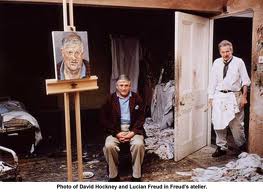
David Hockney 2002

This image for me is fascinating because looking at the actual size of the painting placed on easel of David Hockney. Everything around the room has an air of neglect and you can see the fabric which is strewn across the studio room which seemed to have been used in other work of Freud's.


This another image taken from this particular book, and Freud's studio in summer could be very hot and stuffy and he would often remove his shirt during these times, what does interest me is the apparent chaos of his brushes and paints, the paint marks splattered on the wall behind him is all so random and disorganised and Freud is dynamic and fluid in this image, and yet when you glance at how his shirt and tie is placed, seems out of place within this image.


Nan Goldin Born1953

Nan Goldin is known for documenting her surrogate family of friends as they engage in intimate, uninhibited, or illicit activities. These unusually lit images are frank confrontations with personal experience, frequently presented in poses that mimic the styles of the fashion world. Goldin visited that world through photographs she took for a New York Times Magazine cover story – “James is a Girl,” by Jennifer Egan – that appeared on February 4, 1996. King’s languid and mature pose in this photograph speaks of a teenager who has experienced much; it appeared in a cropped form on the magazine’s cover.

Nan Goldin has spent more than twenty-five years creating edgy portraits. In 1996 these startlingly direct color images were the subject of a mid-career retrospective organized by the Whitney Museum of American Art, New York, which traveled to Winterthur, Germany; Vienna; and Amsterdam, among other international venues. She has earned the Mother Jones Photography Award, a grant from The National Endowment for the Arts, and the Maine Photographic Workshop Book Award for Documentary Book of the Year. Born in Washington, DC in 1953, Goldin earned her BFA (1977) and 5th Year Masters Certificate from The School of The Museum of Fine Arts, Boston.


Nan Goldin’s work is blunt and her work is unforgiving not only to the viewer but of the person being photographed and the unforgiving nature is reflective within my recent images taken of Emma.

Furthermore Nan Goldin’s images do not come across as professional and there is no sense of predetermined aspects when the image is taken, rather the work is reflective of capturing a moment in her life and there is no contrition reflected.

Furthermore my images are imperfect and at times there is graininess due to the fact I do not have an expensive camera to use, however this does not detracted from the starkness of the images.   


Nan Goldin 1997


Holly Roberts

Roberts excels by rewarding us with her sensuous presentations of complex ideas that switch on our senses and logical facilities. Her slow-time pictures extend the most vital experience of photography, the interaction period between the subject and the maker, to express potential realities that comprise human consciousness and ask for a studied examination. Hopefully, Roberts fingerprints, that critical juncture where nature, knowledge, and knower intersect, will lead us to more carefully notice how vast, interrelated, and astonishing our world really is. Robert Hirsch.


30+ years of paintings, talked about one painting at a time: what went into the paintings, what I was trying to say, what was happening at the time of my life that I made the paintings. The paintings themselves are narrative, and this adds a little more to the story that they tell.


Lately I have been working into the photographs using inks and pens, furthermore I have been scratching into the pieces.

 Asking for Money - Holly Roberts

When looking into the work of Holly Roberts I do find her techniques really interesting which does relate to my work. One of her works ‘Asking for Money’ is such an interesting layered piece, and the complex characters that are revealed have an element of creatures/animals this piece that I do find curious. 
Bob Singing - Holly Roberts
 
Whereas the piece ‘Bob Singing’ is an simplistic piece and yet I find the marks and shading reflected in some of my photographs especially the ones that I took of myself and then these were worked into.

However I do find some of the pieces of Roberts a little bit twee and dainty at times, however this does not detract from the mark making and technical work that is reflected within her work.


As I have been creating ink drawings I have looked at the work of Marlene Dumas (b.1953) her work is also very raw and confrontational at times. She works from newspaper cuttings and photographs never from life. Dumas does not shy away from pornography, death, murderers she explores all aspects of human identity. Her paintings are loose and fluid which is how her compostions aspects of her work feel as well.  
 
Amy Blue 2011
 
"Stressing both the physical reality of the human body and its psychological value.Dumas tends to paint her subjects at the extreme fringes of life's cycle, from birth to death, with a continual emphasis on classical modes of representation in Western Art, such as the nude or the funerary portrait. By working within and also transgressing these traditional historical antecedents, Dumas uses the human figure as a means to critique contempory ideas of racial, sexual and social identity." 


Wednesday, 10 October 2012

Reading Group


This reading group was to help myself and Amelia in preparation for the essay that is required for this module, therefore these are the notes that I wrote down as the session took place, these notes may not seem coherent to others! But I know they will be invaluable to me in the future.

The four words that I relate to my practice at this moment in time.


Painterly Process

Deal with Identity

The imagery is expressive

Portrait Style


When writing about my work how I make a statement or a claim I have to be able to give an example.

For instance I began by stating that my portrait style is pushing the boundaries of traditional portraiture when really I should state that I am playing with the boundaries of traditional portraiture this statement allows some discussion within the context of an essay.

When looking at my work it is exploration, relentless, confrontational, disturbing, no escaping the visual impact, there is an undercurrent of unsettling emotions. There is a sense of voyeurism.

Angela suggested that the work of Nan Golding is someone I should be looking at as there are references to my work because there is no apology for her subject matter and her approach, she makes no attempt to neaten the image, the viewer can take it or leave it.

Angela also suggested the work of Holly Roberts because she takes portrait pictures of people and then paints into the images, almost removing the element of photography and creates a metamorphosis of some creature unrelated to the original image removing the identity of the original person within the photograph, there is a loss of evidence of the original layer so the final image is very ambiguous, her work is about introducing different layers through the material process. However my work does differ from the work of Holly Roberts because her work can be quaint.

When referring to another artist be very clear why they relate to your work and the differences.

Materials and processes

Themes and enquires in questions 

I suggested that the photographs of Lucien Freud working in his study are interesting to me and as we looked at the imagery the only relevance really was the atmosphere.

So when looking at artists look at what may be relevant or similar and/or different, learn by looking

My images are cropped the images of Freud are special – so what association do I actually have with Freud?

I also suggested the work of Frida Kahlo her work is reflective, interesting style, duality, alter ego. However Kahlo as an artist is over exposed and an obvious reference to use as she spent her life exploring identity in her representational paintings. This is the same issue when looking at the work of Jenny Saville, so Angela suggested that you can flag up that you know about their work, investigate how and whether they can relate more to the work you are producing but then stop.

I need to read around Nan Golding and when I have learnt all I need to know and which is relevant regarding my work stop.

Find two or three artists or movements that are in context for your work.

Furthermore regarding my work I need to constrain myself to keep working within the shower room, the room is my boundary.

Choose what to focus on now: Looking at Gaze, Ego, Feminism


Amelia suggested that I consider Anish Kapoor when thinking about the mirror:

Concave, top of orbit, positioning yourself of the viewer, formal qualities, fragmentation, disorientation, mirrors challenge representation, he disrupts the understanding of the viewer.

So Anish Kapoor could be someone I could associate with.

Helen Chadwick, Laura Knight are other artists which I should look at

Methods, Methodology – more into photography or mirrors.

So find another 4 words or next piece of work- keep researching and see what relates and does not relate keep a check against the lists.

For instance Kahlo do I need to use her or not?

Don’t package the essay with stuff that doesn’t matter

As look at German photographers regarding young people – there is a relationship with the camera and young people, teenage photography confrontational.

Also Hockney talks about photography regarding reality – so selective not reactive of life, the reality of who you are in a photograph.

Furthermore software is changing photography, there are now apps for hyper realistic and painterly interventions.

Wednesday, 3 October 2012

A way of life? or Identity

My work life as a Medical Laboratory Assistant and when you take into the ratio of male MLA's to female MLA's there is a vast and distinctive difference because this particular role is usually filled by woman, it is underpaid and we are distinctly undervalued and it has always been like that since the post of MLA's was created.
My home life is not unusual by any means but it is not easy and once again its a common situation for the single parent to be female on a low wage struggling to survive and I am not an isolated group because this situation happens to many woman from many different backgrounds.
So within my creative work I look at my life and how my work interprets that particular arena and how I have extended this by attempting to visually creative some form of dialogue regarding my daughter's particular generation and this particular age group and the emotional and physical issues is hard to define.

However I have found a quote that for me does sum up how I feel about my work at this moment in time.

Lucy R Lippard argument is used within a discussion regarding feminist art in the book Art and Feminism, Lippard declares that feminist art is "Neither a style nor a movement' but rather a value system, a revolutionary strategy, a way of life".(1982:20)

Therefore I want to ask the question or rather am I not understanding Art and Identity by feeling that maybe Identity is a way of life for individuals and how they live and what is reflected within that sphere 'Identity'. 

Any moving on the work I have recently made, I was incredibly impressed with the level of work being produced by other MA students and I have felt very inadequate and awestruck, and I have been inspired to create work using ink to sketch with and I have only produced these two images, what is interesting about these pieces is that I have attempted not to copy the photographic images but to be inspired by them from memory therefore they are not a true representation and in doing this the reality has been removed and the essence of the image remains.   


I have continued to create more ink sketches using a variety of coloured inks and I started off looking at creating ink images of Emma's face.


Due to comments made by students and also tutors I am aware of how I compositionally positions the image on the paper and how they differ from when I am taking photographs.


Recognising that when I use different mediums I see visually a different way of positioning of the object/person. This is a very interesting area for me to look at as the MA continues.


I have looked at the work of Marlene Dumas and I am interested in how she uses the gradient of colour within her work, and within these ink drawings I have been experimenting with certain colours. As you can see above in the variety of ink sketches that I have created.
Furthermore I have attempted to create a large piece once again using the blueish hues.


Within the piece above the looseness of the brushstrokes seem to be scratchy and the body seems mishaped and the stance is awkward, the eyes are averted, this piece is difficult and I feel as a viewer very uncomfortable to look at which is an element which fits within this image.
 
This module has been difficult and complex and time has been a terrible issue on top of everything else, I hope that I can develop from this module and learn from the issues which have arisen.


 I created this finale piece and I know that it is not like the paintings that I usually make, but the contrasting elements of the oil paints and watercolour inks creates a nightmarish element and the face is distorted and not much like my daughter's.
However there is a finality to this piece which for me is a positive conclusion to this module.

The work in this module has been based around the book 'Art and Today' and the chapter 'Art amd Identity' by Eleanor Heartney because Identity has been underlying my throughout this module, I started of exploring that develop and mould my identity through society in which I live, our lives change and shift and so does our identity. I found that when myself and my daughter collaborated that this work was about defining ourselves as individuals and how difficult this is at the age of fourteen as you develop into adulthood leaving childhood behind.

Considering the work I have created during this module I have thought about how I would like them to be displayed during the assessment when taking all of these images and what they mean and how the viewer will see these pieces.
So I have put a note into the parcel which will be sent off to the OCA, and in I have asked that the painting by hung up and either side I want the ink drawings pinned up, furthermore I have printed off 20 photocopies of my daughter and I want these scattered onto the floor leading up to the images, so the viewer will have to either avoid stepping or actually step onto these images. Because these images regarding Emma are about how we as adults often ignore or avoid any confrontation regarding teenagers, we prejudge what they may be interested in and what affects these individuals during this stage in their lives.

Finally Caroline and I have discussed who the photographs of my daughter is disturbing and fboth myself and Caroline realised that these images have a sense of the images of Leah Betts (b.1977 d.1995) there was an image of her on a ventilator which raised the profile of the drug ecstasy and also the images of Rachel Whitear (b.1979 d.2000) she died from a heroin overdose, which led to a large scale anti-drugs campaign.  


Leah Sarah Betts (1 November 1977[1] – 16 November 1995